The Leadership Gap in Veterinary Medicine
Veterinary medicine has never lacked heart.
Every day, veterinary professionals show up for frightened patients, grieving families, and teammates carrying invisible burdens. They work long hours, miss holidays, sacrifice sleep, and continue giving even when their own emotional reserves are depleted.
What veterinary medicine often lacks isn’t compassion.
It’s balance.
For years, leadership conversations in our industry have fallen into two categories.
On one side are leaders who focus almost exclusively on people. They care deeply about their teams, prioritize relationships, and strive to create supportive workplaces. While admirable, these leaders sometimes struggle with accountability, operational efficiency, and sustainable business practices.
On the other side are leaders who focus primarily on metrics. Productivity, revenue, efficiency, and performance become the primary measures of success. While these leaders often achieve strong business outcomes, they may unintentionally create environments where burnout, disengagement, and turnover flourish.
The result is an industry caught between two extremes.
The answer is neither.
The answer is both.
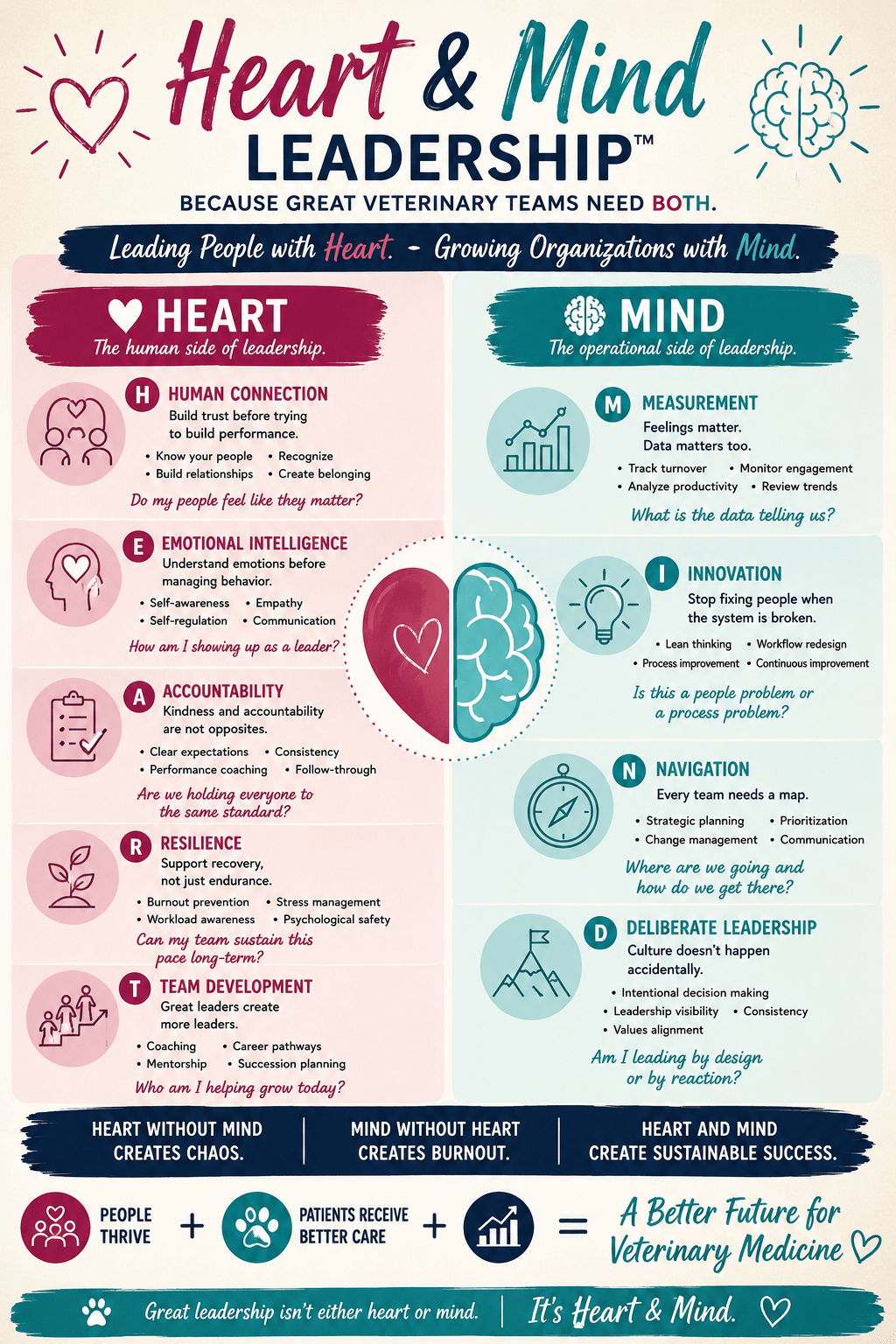
Introducing the Heart & Mind Leadership™ Framework
Heart & Mind Leadership™ is built on a simple belief:
Great organizations require both emotional intelligence and operational excellence.
Compassion without structure creates chaos.
Structure without compassion creates burnout.
Sustainable success occurs when leaders learn to balance both.
The framework consists of two interconnected dimensions:
HEART
The human side of leadership.
MIND
The operational side of leadership.
Together, they create cultures where people thrive and organizations perform.
HEART: Leading People Well
Human Connection
Employees do not leave organizations where they feel genuinely valued.
Human connection is the foundation of trust, engagement, and retention.
Leaders who prioritize human connection take time to know their team members as individuals. They recognize accomplishments, celebrate growth, and create environments where employees feel seen and appreciated.
The question every leader should ask is:
“Do my people feel like they matter?”
Emotional Intelligence
Technical expertise may earn someone a leadership position.
Emotional intelligence determines whether they succeed in it.
Emotionally intelligent leaders understand how their emotions influence others. They communicate effectively, navigate conflict professionally, and respond thoughtfully rather than react impulsively.
When emotional intelligence is present, communication improves, conflict decreases, and trust grows.
Accountability
Many leaders view accountability and empathy as opposing forces.
They are not.
In fact, accountability is one of the highest forms of respect.
Employees deserve clear expectations, honest feedback, and consistent standards. High-performing cultures are built when leaders address issues directly, coach effectively, and hold all team members accountable regardless of position or tenure.
Healthy accountability creates fairness, trust, and reliability.
Resilience
Veterinary medicine will always be stressful.
Burnout, however, should never be accepted as inevitable.
Resilient organizations create systems that support recovery, not just endurance. They recognize that employee wellbeing directly impacts patient care, client service, and organizational performance.
The goal is not to eliminate stress.
The goal is to ensure stress is recoverable.
Team Development
Strong leaders do more than manage today’s performance.
They build tomorrow’s leaders.
Organizations that invest in mentorship, coaching, cross-training, and career development create stronger teams, higher engagement, and more internal promotion opportunities.
Leadership is not measured by how many people follow you.
Leadership is measured by how many people grow because of you.
MIND: Leading Organizations Well
Measurement
Feelings matter.
Data matters too.
Organizations that fail to measure turnover, engagement, absenteeism, productivity, and employee satisfaction often discover problems only after employees resign.
Measurement provides leaders with visibility.
The goal is not to reduce people to numbers.
The goal is to use data to identify opportunities for improvement before they become crises.
Innovation
One of the most common mistakes leaders make is assuming every problem is a people problem.
Often, it is a systems problem.
Innovation requires leaders to examine workflows, communication processes, staffing models, and operational barriers before assigning blame.
When leaders improve systems, employees can focus on delivering exceptional care rather than navigating unnecessary frustration.
Navigation
Change is constant in veterinary medicine.
New technology, staffing challenges, evolving client expectations, and industry growth all require leaders to help teams navigate uncertainty.
Employees do not expect leaders to have every answer.
They do expect leaders to provide direction.
Effective leaders serve as navigators, helping teams understand where they are, where they are going, and how they will get there together.
Deliberate Leadership
Culture is not created by mission statements.
Culture is created by repeated behaviors.
Every conversation, decision, and interaction reinforces what an organization truly values.
Deliberate leaders recognize that culture does not happen accidentally. They intentionally model expectations, reinforce desired behaviors, and create alignment between organizational values and daily actions.
They lead by design rather than by default.
Why Heart and Mind Matter Together
Heart without Mind creates organizations that care deeply but struggle to perform consistently.
Mind without Heart creates organizations that perform well but struggle to retain people.
Neither approach is sustainable.
The most successful veterinary organizations understand that patient care, employee wellbeing, and business performance are interconnected.
When employees feel valued, supported, developed, and heard, they perform better.
When organizations operate efficiently, communicate clearly, and make data-driven decisions, employees experience less frustration and greater success.
This is not an either-or equation.
It is a both-and responsibility.
The Future of Veterinary Leadership
The veterinary profession faces significant challenges.
Burnout.
Turnover.
Compassion fatigue.
Staffing shortages.
Leadership development gaps.
Solving these challenges requires a new leadership approach.
One that honors both the human and operational sides of our profession.
One that recognizes that thriving teams and thriving organizations are inseparable.
One that leads with heart and manages with mind.
Because veterinary professionals deserve both compassion and strategy.
And the future of veterinary medicine depends on leaders who can provide both.


Leave a Reply