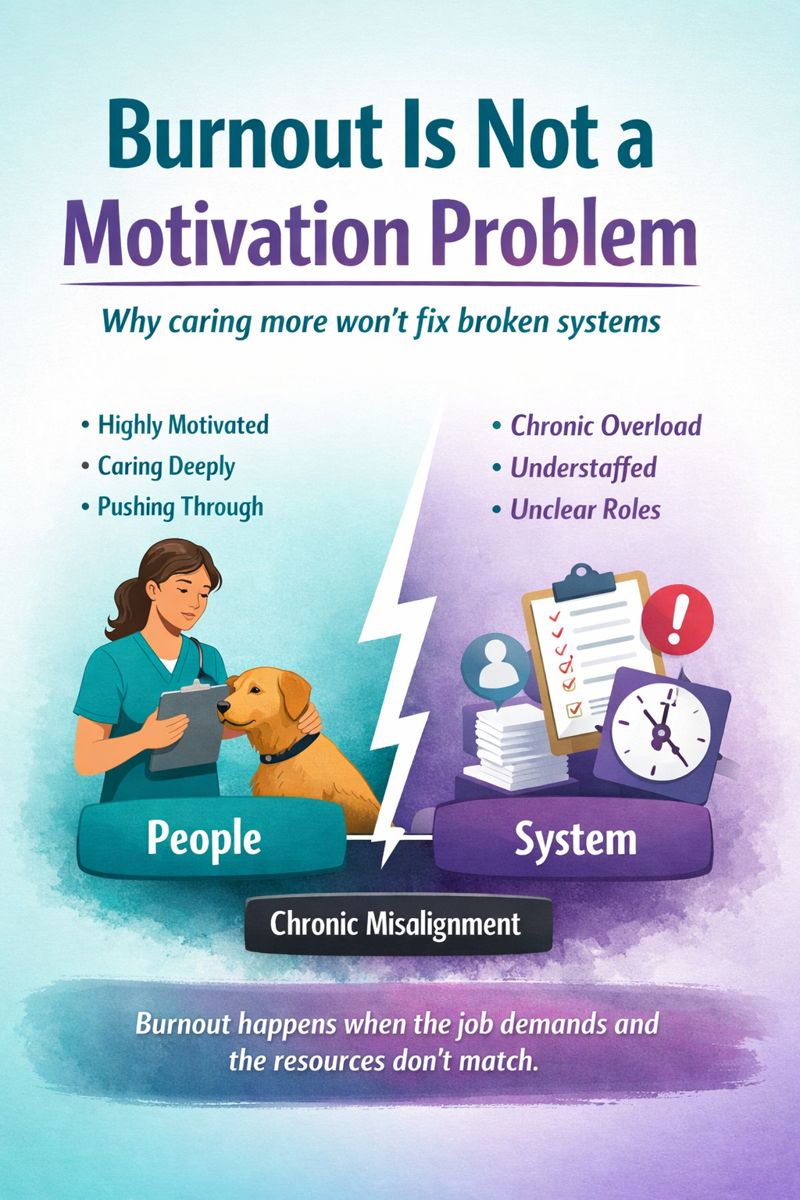
Burnout Is Not a Motivation Problem
Why caring more won’t fix broken systems
Burnout in veterinary medicine is often framed as a motivation issue.
If people are struggling, the assumption is that they need:
- More resilience
- Better coping skills
- A mindset shift
- A reminder of why they chose this work
This framing is understandable. Veterinary professionals care deeply. They are intelligent, committed, and often willing to give more than is asked.
But research tells us something important.
Burnout is not caused by a lack of motivation.
It is caused by chronic misalignment between people and the systems they work in.
What Burnout Actually Is (and Is Not)
Burnout is not simply exhaustion from working hard. According to Maslach and Leiter, burnout emerges when there is a prolonged mismatch between workers and key aspects of their job, including workload, control, reward, community, fairness, and values (Maslach & Leiter, 2016).
In other words, burnout is not about effort.
It’s about fit.
Highly motivated people are often more vulnerable to burnout because they stay longer in unsustainable conditions, believing that caring more will eventually make things better.
It usually doesn’t.
Why Motivation Temporarily Masks Poor Design
Motivation can carry people through short-term strain.
In veterinary medicine, motivation often shows up as:
- Staying late “just this once.”
- Covering gaps without complaint
- Absorbing emotional labor quietly
- Prioritizing patients over personal limits
In the short term, this keeps systems functioning. In the long term, it hides the cost.
Research shows that when job demands consistently exceed available resources, employees experience emotional exhaustion, disengagement, and decreased well-being regardless of their initial motivation or commitment (Bakker & Demerouti, 2017).
Motivation doesn’t fix overload.
It delays the consequences.
The Problem with Praising Endurance
In caring professions, endurance is often rewarded.
People who push through are seen as dedicated. People who struggle are encouraged to “build resilience.” Over time, this creates a culture where suffering becomes normalized and questioning the system feels like personal weakness.
This is especially risky in veterinary medicine, where emotional labor, moral distress, and workload intensity are already high (Bartram & Baldwin, 2010).
When endurance becomes the metric of success, burnout becomes inevitable.
Burnout as a Systems Issue
From an industrial–organizational psychology perspective, burnout is best understood as a systems problem rather than an individual failure.
The Job Demands–Resources model explains burnout as the result of high demands combined with insufficient resources, such as staffing, autonomy, clarity, and support (Demerouti et al., 2001).
No amount of personal resilience can compensate for systems that:
- Are chronically understaffed
- Rely on role ambiguity
- Lack recovery time
- Reward overextension
- Ignore emotional labor
When people burn out in these environments, it is not because they lacked commitment. It is because the work was poorly designed.
Why This Matters for Leaders
When leaders treat burnout as a motivation issue, solutions tend to focus on individuals.
Wellness initiatives.
Self-care reminders.
Encouragement to “take time off” without changing the workload.
While well-intentioned, these approaches fail when the system remains unchanged.
Leaders who want sustainable teams must look upstream at design.
They must ask:
- What demands are consistently exceeding capacity?
- What resources are missing or unevenly distributed?
- What behaviors are being rewarded?
- What costs are being absorbed silently by the team?
Burnout prevention begins with work design, not pep talks.
The Takeaway
Burnout is not a sign that people don’t care enough.
In veterinary medicine, burnout is often evidence that people care deeply inside systems that ask too much for too long.
Designing work that doesn’t hurt people requires leaders to move beyond motivation and look honestly at structure, workload, expectations, and recovery.
People do not need to care more.
They need work that is designed with human limits in mind.
Reflection Question for Leaders
Where might motivation be masking a design problem on your team?
References
Bakker, A. B., & Demerouti, E. (2017). Job demands–resources theory: Taking stock and looking forward. Journal of Occupational Health Psychology, 22(3), 273–285. https://doi.org/10.1037/ocp0000056
Bartram, D. J., & Baldwin, D. S. (2010). Veterinary surgeons and suicide: A structured review of possible influences on increased risk. Veterinary Record, 166(13), 388–397. https://doi.org/10.1136/vr.b4794
Demerouti, E., Bakker, A. B., Nachreiner, F., & Schaufeli, W. B. (2001). The job demands–resources model of burnout. Journal of Applied Psychology, 86(3), 499–512. https://doi.org/10.1037/0021-9010.86.3.499
Maslach, C., & Leiter, M. P. (2016). Understanding the burnout experience: Recent research and its implications for psychiatry. World Psychiatry, 15(2), 103–111. https://doi.org/10.1002/wps.20311


Leave a Reply