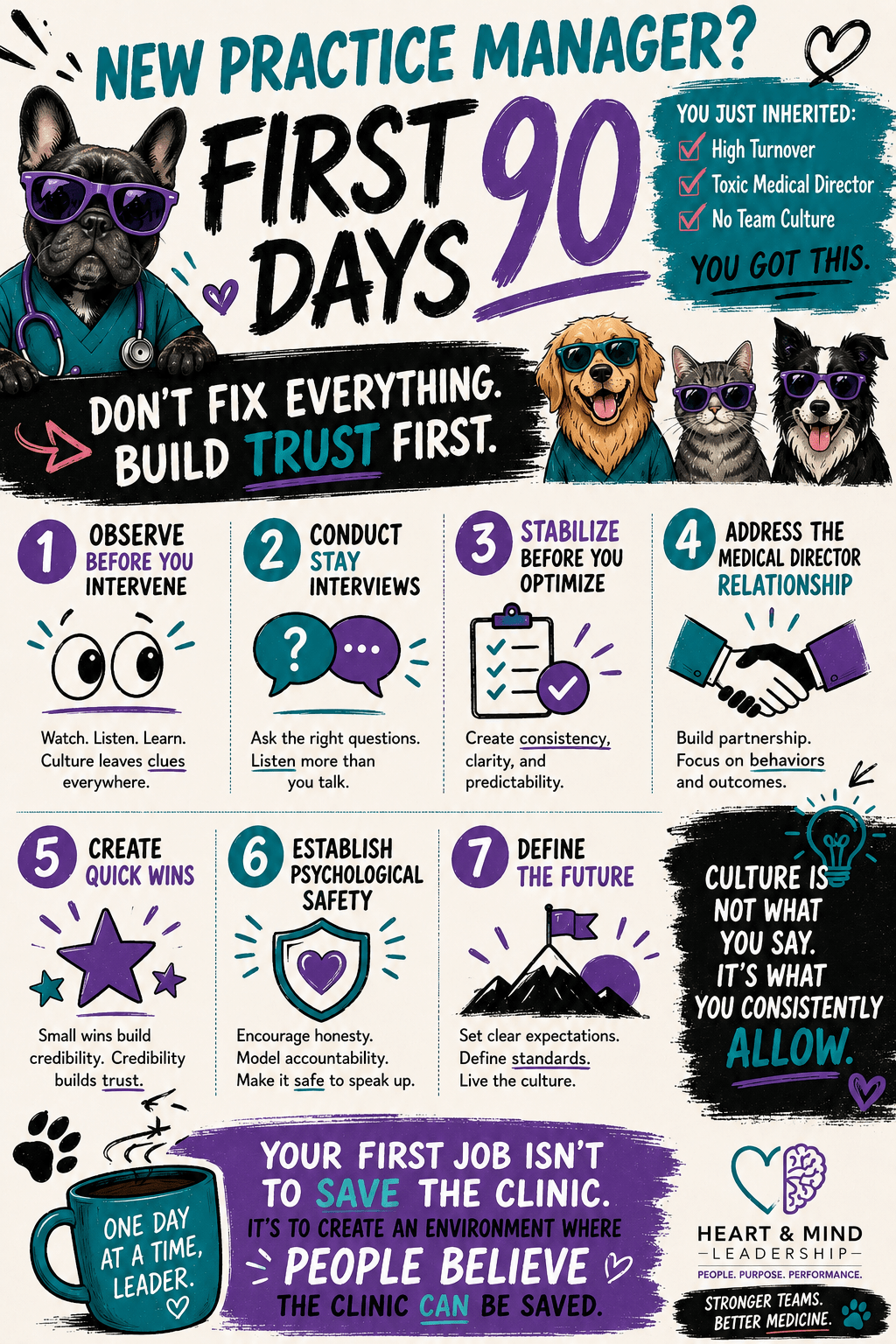
What should a new practice manager do when they inherit high turnover, a toxic medical director, and a team that no longer believes things can improve?
Imagine this scenario:
You walk into your new role as Practice Manager on Monday morning.
The clinic has experienced significant turnover over the past two years. Staff members openly discuss leaving. Morale is low. Departments operate in silos. Gossip travels faster than official communication. Team members are exhausted and distrustful of leadership.
To make matters worse, the Medical Director is highly skilled clinically but creates tension everywhere they go. Conversations often feel critical, dismissive, or confrontational. Staff members avoid interactions whenever possible, and previous managers have either quit or learned to stay silent.
The culture isn’t broken.
The culture doesn’t exist.
Many new leaders make the mistake of trying to fix everything immediately.
That approach almost always fails.
When inheriting a struggling practice, your first responsibility is not to change the culture.
Your first responsibility is to understand it.
Step 1: Observe Before You Intervene
One of the fastest ways to lose credibility is to arrive with a list of solutions before understanding the actual problems.
Spend the first few weeks gathering information.
Observe workflows.
Listen during rounds.
Watch how employees interact with one another.
Pay attention to what is said—and what isn’t.
Look for recurring themes:
- Where does communication break down?
- What frustrates employees most?
- Which processes create unnecessary stress?
- What behaviors are being rewarded?
- What behaviors are being tolerated?
Culture leaves clues everywhere.
Your job is to find them.
Step 2: Conduct Stay Interviews
Before making major changes, meet individually with every team member.
Not performance reviews.
Not disciplinary meetings.
Conversations.
Ask questions such as:
- What do you enjoy most about working here?
- What makes your job difficult?
- If you could change one thing tomorrow, what would it be?
- What keeps you here?
- What makes you consider leaving?
- What do you wish leadership understood?
Then listen.
Not to defend.
Not to explain.
Not to justify.
Simply listen.
Patterns will emerge quickly.
Step 3: Stabilize Before You Optimize
Many leaders rush into new initiatives, training programs, and policy changes.
The team isn’t ready for that yet.
Employees who have experienced chaos don’t need inspiration.
They need stability.
Focus on creating predictability:
- Consistent scheduling
- Clear communication
- Defined expectations
- Reliable follow-through
- Fair accountability
Trust begins to grow when people can accurately predict what leadership will do.
Step 4: Address the Medical Director Relationship
This is where many managers struggle.
The temptation is to immediately confront the toxic behavior.
Resist that urge.
Instead, build a professional partnership first.
Schedule regular leadership meetings.
Establish shared goals.
Focus discussions on business outcomes, employee retention, client experience, and patient care.
When concerns arise, use objective observations rather than emotional accusations.
Instead of:
“The staff thinks you’re toxic.”
Try:
“We’ve had multiple team members express concerns about communication. I’d like us to work together on creating a more productive environment because turnover is impacting patient care.”
Keep discussions focused on behaviors and outcomes.
Not personalities.
Not labels.
Not opinions.
The goal is influence, not victory.
Step 5: Create Quick Wins
Employees in struggling clinics often feel leadership never follows through.
Find opportunities to solve small but meaningful problems quickly.
Examples might include:
- Improving communication systems
- Fixing scheduling frustrations
- Updating broken equipment
- Clarifying responsibilities
- Streamlining inefficient processes
Quick wins build credibility.
Credibility creates trust.
Trust creates buy-in.
Buy-in creates change.
Step 6: Establish Psychological Safety
Teams cannot improve when employees fear speaking honestly.
Psychological safety doesn’t mean lowering standards.
It means creating an environment where concerns can be raised without fear of humiliation or retaliation.
Encourage respectful disagreement.
Ask for feedback.
Acknowledge mistakes openly.
Model accountability yourself.
The culture will always mirror leadership behavior.
Step 7: Define the Future
Once stability has been established, begin creating a vision for the practice.
Not a slogan.
Not a poster.
A clear picture of how people should work together.
Define:
- Communication expectations
- Leadership expectations
- Team standards
- Client service standards
- Accountability standards
Culture is not what leadership says.
Culture is what leadership consistently allows.
The Reality of Culture Change
Many managers inherit organizations that have been struggling for years.
They hope to fix everything in a few months.
That rarely happens.
Real culture change is not built through motivational speeches or pizza parties.
It is built through hundreds of consistent interactions over time.
Every conversation.
Every decision.
Every coaching moment.
Every difficult discussion.
Employees begin to trust leadership when leadership becomes predictable, fair, and consistent.
If you’re taking over a struggling veterinary practice, remember this:
Your first job is not to save the clinic.
Your first job is to create an environment where people believe the clinic can be saved.
Everything else grows from there.


Leave a Reply