Category: Uncategorized

  • How Lean Six Sigma Can Be Applied to Veterinary Medicine (Without Losing the Human Side)

    How Lean Six Sigma Can Be Applied to Veterinary Medicine (Without Losing the Human Side)

    Lean Six Sigma is often misunderstood in veterinary medicine.

    It’s frequently associated with manufacturing, rigid productivity metrics, and pressure to do more with fewer people. In a profession built on care, ethics, and emotional labor, that association can feel deeply misaligned.

    But Lean Six Sigma, when applied correctly, is not about squeezing people.

    It is about removing unnecessary friction from systems so teams can provide care without constant strain.


    What Lean Six Sigma Actually Is

    Lean Six Sigma combines two complementary approaches:

    • Lean focuses on eliminating waste, redundancy, and unnecessary steps
    • Six Sigma focuses on reducing variation and errors through reliable processes

    The goal is not speed alone.
    The goal is clarity, consistency, and safety.

    In healthcare settings, Lean Six Sigma has been shown to improve workflow efficiency, reduce errors, and lower staff stress when applied thoughtfully and ethically (DelliFraine et al., 2014; Holden, 2011).


    Why Veterinary Medicine Is Ripe for Systems Improvement

    Veterinary teams often experience stress not because they lack skill or commitment, but because systems add unnecessary complexity.

    Common pain points include:

    • Inconsistent intake processes
    • Poor handoffs between roles
    • Redundant documentation
    • Unclear task ownership
    • Bottlenecks that trigger chaos during peak hours

    These inefficiencies increase cognitive load, emotional labor, and error risk, particularly under time pressure.

    Lean Six Sigma helps identify where work is harder than it needs to be.


    Where Lean Thinking Helps Most in Vet Med

    Lean begins with one core question:

    Which steps add value to patient care, and which steps add burden without benefit?

    In veterinary medicine, Lean thinking can:

    • Clarify workflows so teams aren’t constantly improvising
    • Reduce decision fatigue during busy periods
    • Improve communication across roles
    • Decrease client frustration by creating predictable processes

    Importantly, Lean protects professional judgment by removing unnecessary noise around it.


    Six Sigma and Error Reduction in Clinical Care

    Six Sigma focuses on reducing variation that increases risk.

    In veterinary clinics, variation often appears as:

    • Different medication prep methods
    • Inconsistent anesthesia protocols
    • Variable discharge instructions
    • Uneven training across shifts

    Research shows that standardization of routine clinical processes reduces error rates and improves safety in healthcare environments (Pronovost et al., 2006).

    This does not eliminate autonomy.
    It creates reliable defaults so clinicians can focus on complex decision-making.


    Emotional Labor and Inefficient Systems

    Inefficiency does more than waste time.

    It increases emotional labor.

    When systems fail, teams absorb:

    • Client frustration
    • Team conflict
    • Moral distress from rushed care
    • Anxiety about mistakes

    Emotional labor is strongly associated with burnout when it is chronic and unsupported (Grandey & Gabriel, 2015).

    Reducing inefficiency is not just operational.
    It is psychological harm reduction.


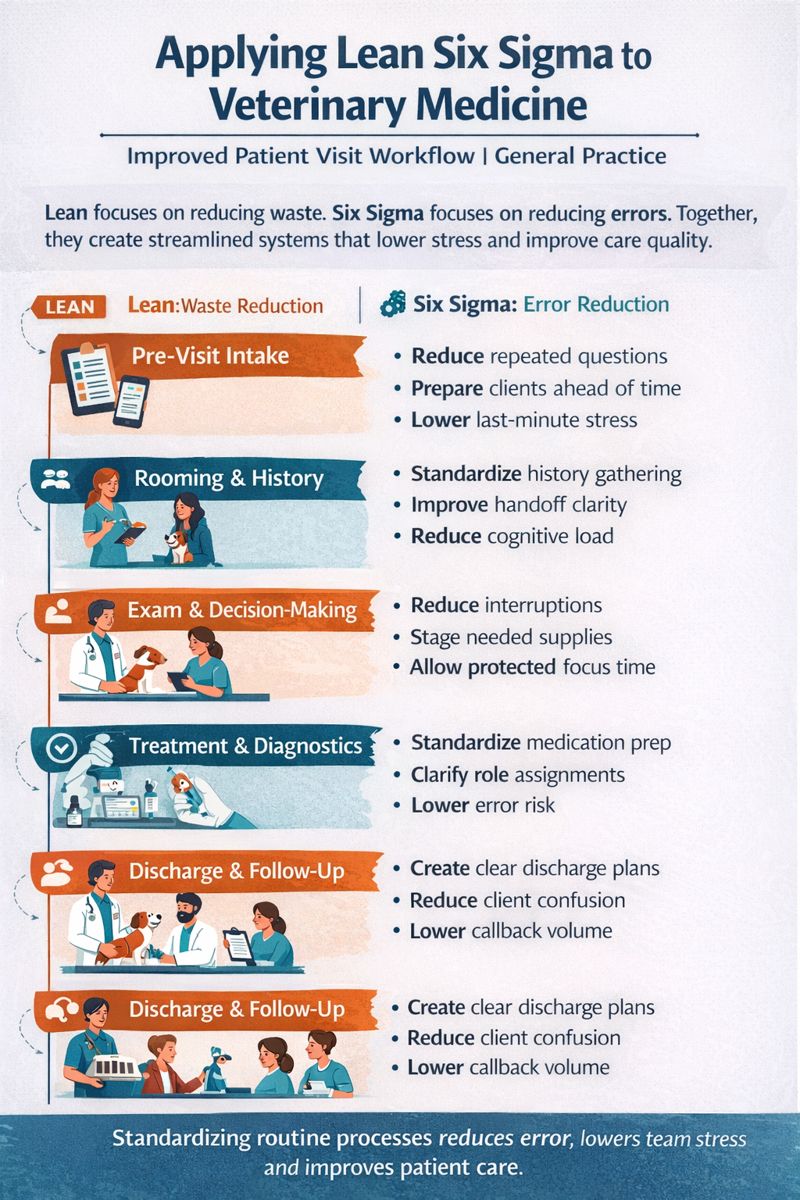
    Sample Lean Six Sigma Workflow: General Practice Veterinary Clinic

    Below is an example of how Lean principles can be applied to a routine wellness + sick visit workflow.


    Before: Common Pain Points

    • Client arrives without clear intake expectations
    • Technician gathers history multiple times
    • Veterinarian interrupted repeatedly during exam
    • Missing supplies delay diagnostics
    • Discharge instructions rushed or inconsistent

    Result:

    • Increased stress
    • Longer appointments
    • Frustrated clients
    • Team tension

    After: Lean-Informed Workflow Design

    1. Pre-Visit Intake (Lean: Waste Reduction)

    Design changes

    • Standardized digital intake form completed before arrival
    • Clear appointment type selection (wellness vs sick vs recheck)
    • Automated reminders outlining what to expect

    Impact

    • Reduces repeated questioning
    • Improves appointment preparedness
    • Lowers client anxiety

    2. Rooming & History (Lean + Six Sigma)

    Design changes

    • Technician follows a standardized history checklist
    • Information documented in one location
    • Clear criteria for escalation or diagnostics

    Impact

    • Reduces variation
    • Improves handoff quality
    • Lowers cognitive load

    3. Exam & Decision-Making (Lean: Protecting Value-Added Work)

    Design changes

    • Veterinarian protected from interruptions during exam
    • Technician assigned as primary support
    • Supplies pre-staged for common diagnostics

    Impact

    • Improves focus
    • Reduces delays
    • Enhances care quality

    4. Treatment & Diagnostics (Six Sigma: Error Reduction)

    Design changes

    • Standardized medication prep and labeling
    • Checklists for anesthesia and procedures
    • Clear role assignments during treatment

    Impact

    • Reduces errors
    • Improves team coordination
    • Builds trust

    5. Discharge & Follow-Up (Lean: Flow + Clarity)

    Design changes

    • Standard discharge templates customized per case
    • Written and verbal instructions aligned
    • Clear follow-up plan communicated

    Impact

    • Reduces client confusion
    • Lowers callback volume
    • Improves adherence

    What Changed?

    Not the people.
    The system.

    By removing redundancy, clarifying roles, and standardizing routine steps, the clinic reduced stress without increasing speed or caseload.


    What Lean Six Sigma Should NOT Do in Vet Med

    Lean Six Sigma should never be used to:

    • Increase appointment volume without support
    • Justify understaffing
    • Eliminate recovery time
    • Measure productivity without context

    When efficiency is used without regard for human limits, burnout increases. That is not Lean. It is a misuse.


    The Takeaway

    Lean Six Sigma, when applied ethically, is not about doing more with less.

    It is about doing meaningful work with less friction, less confusion, and less harm.

    Veterinary medicine doesn’t need industrial thinking.
    It needs humane systems thinking.


    Reflection Question for Leaders

    Where might inefficient processes be increasing stress and emotional labor for your team without improving care?


    References (APA)

    DelliFraine, J. L., Langabeer, J. R., & Nembhard, I. M. (2014). Assessing the evidence of Six Sigma and Lean in the health care industry. Quality Management in Health Care, 23(1), 3–14. https://doi.org/10.1097/QMH.0000000000000004

    Grandey, A. A., & Gabriel, A. S. (2015). Emotional labor at a crossroads. Annual Review of Organizational Psychology and Organizational Behavior, 2, 323–349. https://doi.org/10.1146/annurev-orgpsych-032414-111400

    Holden, R. J. (2011). Lean thinking in emergency departments. Annals of Emergency Medicine, 57(3), 265–278. https://doi.org/10.1016/j.annemergmed.2010.08.001

    Pronovost, P., Needham, D., Berenholtz, S., et al. (2006). An intervention to decrease catheter-related bloodstream infections. New England Journal of Medicine, 355(26), 2725–2732. https://doi.org/10.1056/NEJMoa061115

  • Emotionally Intelligent Leadership Tools

    A practical series for leading humans doing hard work

    This series is for leaders who care deeply, work in high-pressure environments, and want tools that actually help teams function better, not just sound good in theory.

    Each post introduces one emotionally intelligent leadership tool, explains why it works, and shows how to use it without undermining professionalism or accountability.

  • Emotionally Intelligent Leadership Tool #1 : The Reset Tool

    Do you consider yourself a fun leader?

    I do. And I’m not afraid to say it.

    Not because work is a joke, but because tension is real, especially in veterinary medicine, and teams need healthy, intentional ways to release it.

    Fun leadership is often misunderstood. It gets lumped in with being unserious or unprofessional. But in my experience, the opposite is true. Fun, when used intentionally, is a form of emotional intelligence.

    Why Fun Matters in High-Stress Work

    Veterinary teams carry an enormous emotional load.

    High stakes.
    Time pressure.
    Client emotion.
    Moral stress.

    When that pressure builds with no release, it doesn’t disappear. It turns into irritability, withdrawal, conflict, or burnout.

    That’s why I’ve always believed leadership includes helping teams regulate, not just perform.

    Sometimes that regulation looks like calm presence and direct conversation.
    And sometimes it looks like doing something a little ridiculous on purpose.

    Singing, Dancing, and Doing Slightly Ridiculous Things

    I’ve been known to break up a stressful moment by singing, dancing, or doing something unexpected. Not to minimize what’s happening, and not to avoid hard conversations—but to remind people of something important.

    We’re human.
    We’re under pressure.
    And we’re in this together.

    A brief moment of levity can interrupt a stress spiral long enough for the nervous system to reset. When people can breathe again, they can think again.

    That’s not accidental.
    That’s leadership.

    Enter: Moose Ears

    One of my favorite stress-reset strategies came from an unlikely place. I saw a young woman on TikTok hold her hands to her head like antlers and bellow loudly to release stress. My immediate reaction was, that’s actually brilliant.

    So we tried it.

    Now, when the team is frustrated or stuck in a funk, someone will call out “moose ears.” Everyone puts their hands on their head like antlers and lets out a big bellow.

    Is it silly? Absolutely.
    Is it professional? Surprisingly, yes.

    Because that brief, shared moment does something important.

    It releases tension.
    It breaks the stress loop.
    It creates connection and laughter.
    It helps the team reset and refocus.

    No one pretends the stress isn’t real. We just refuse to let it own the room.

    Fun Leadership Is Not Avoidance

    This part matters.

    Using humor well is not the same thing as avoiding reality. Fun leadership is not toxic positivity. It’s not bypassing conflict or glossing over hard days.

    It’s about timing and intention.

    It’s knowing when a team needs grounding and when they need permission to laugh. It’s understanding that emotional intelligence includes reading the room, not just managing tasks.

    Fun leadership works because it creates psychological safety. It tells teams, you don’t have to hold everything alone.

    Why Fun Strengthens Leadership Instead of Undermining It

    Fun doesn’t undermine leadership.

    When used intentionally, it strengthens it.

    Teams are more likely to trust leaders who feel human. They’re more likely to speak up, recover from mistakes, and support one another when the environment feels safe enough to breathe.

    Leadership doesn’t have to feel heavy all the time to be effective. In fact, when leadership always feels heavy, it’s worth asking why.

    Sometimes the most emotionally intelligent thing a leader can do is create a shared moment of release, then guide the team back to work with clarity and care.

    A Question for You

    How do you help your team reset when stress is high?

    Whether it’s humor, movement, quiet grounding, or something else entirely, the goal is the same. Help people come back into themselves so they can show up fully for the work.

    That’s not frivolous.

    That’s leadership.