Leadership conversations in Veterinary Medicine often focus on operational performance.
Metrics.
Staffing.
Efficiency.
Client satisfaction.
All critical.
But there is a quieter leadership variable that influences every one of those outcomes, and it rarely makes it onto dashboards.
Emotional predictability.
Or more specifically, the absence of it.
Because when leadership emotional regulation is inconsistent, the entire clinic nervous system destabilizes.
Not metaphorically.
Neurologically. Behaviorally. Operationally.
Emotional Contagion Is Not Theoretical
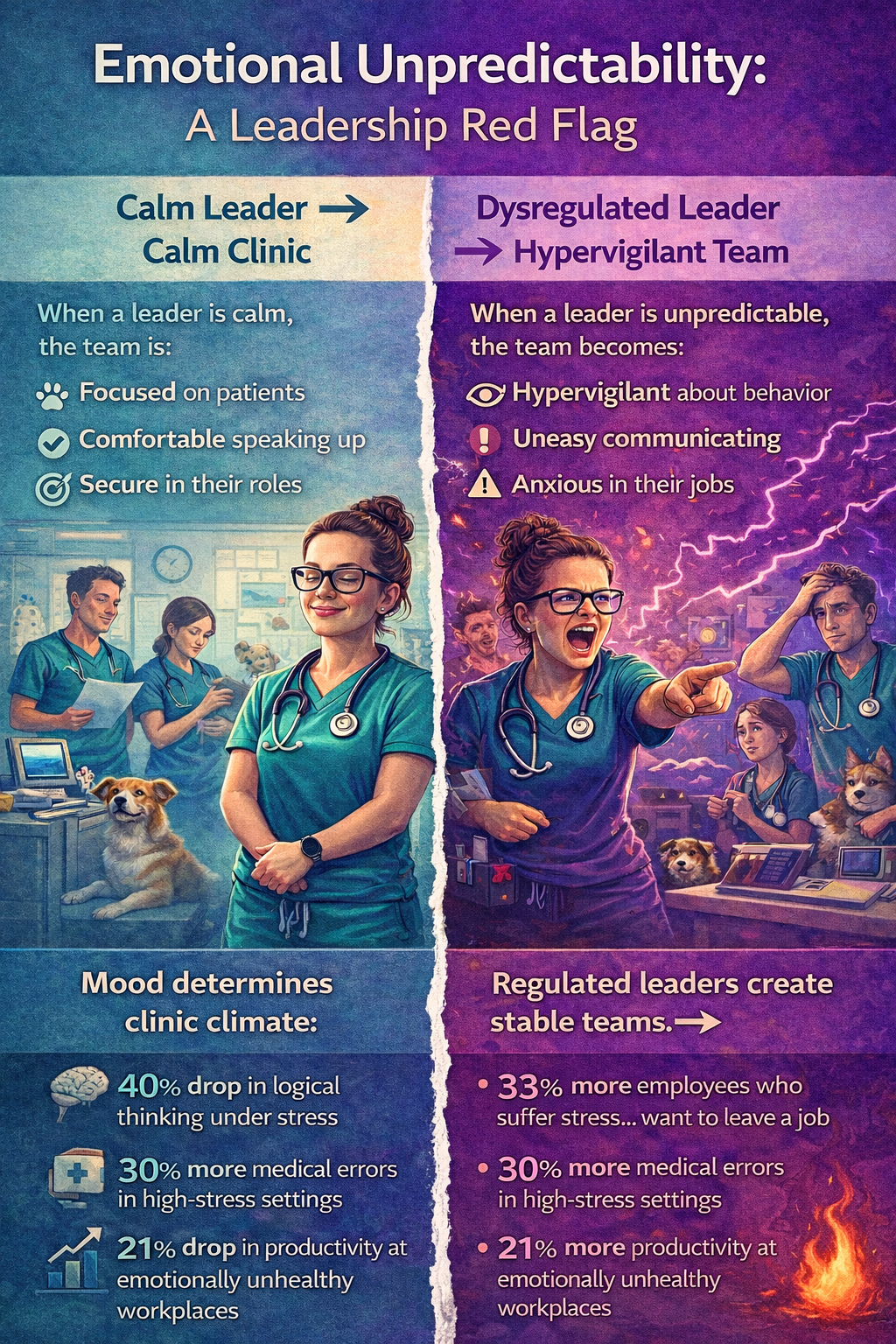
Research in organizational psychology describes a phenomenon called emotional contagion.
Teams unconsciously mirror the emotional state of the most influential person in the environment, typically the leader.
When leaders are grounded, communication stabilizes. Decision-making improves. Psychological safety increases.
When leaders are emotionally unpredictable, teams shift into hypervigilance.
They begin monitoring mood instead of focusing on medicine.
What Emotional Unpredictability Looks Like In Practice
It rarely shows up as intentional harm.
More often it looks like:
Calm one moment, reactive the next
Supportive one day, critical the following
Engaged in meetings, withdrawn on the floor
Approachable during low stress, volatile during high stress
Over time, staff stop focusing on performance expectations and start focusing on emotional risk assessment.
Questions shift from:
“What does the patient need?”
To:
“What version of leadership am I walking into today?”
The Impact On Teams
When leadership emotional tone is inconsistent, three predictable outcomes emerge.
1. Hypervigilance
Staff begin scanning leadership behavior for cues of safety or threat.
This cognitive load reduces focus on clinical tasks and increases mental fatigue.
2. Communication Avoidance
Employees hesitate to escalate concerns, clarify orders, or admit mistakes due to fear of reaction rather than fear of consequence.
This has direct patient safety implications.
3. Role Insecurity
Even high performers begin questioning job stability, expectations, and psychological safety when leadership reactions feel unpredictable.
Operational Consequences
Emotional unpredictability is not just cultural. It is operational.
Research across healthcare and organizational psychology links emotionally dysregulated environments to:
Reduced logical thinking under stress
Increased medical error rates
Higher turnover intent
Decreased productivity
Lower psychological safety scores
When the nervous system is in threat mode, executive functioning declines.
Clinical judgment suffers.
Why This Matters More In Veterinary Medicine
Veterinary teams already operate under chronic emotional strain:
Euthanasia exposure
Financial conflict conversations
Client grief processing
Compassion fatigue
Understaffing pressure
This baseline stress load means leadership regulation is not optional.
It is protective infrastructure.
A regulated leader becomes a stabilizing force.
An unregulated leader becomes an amplifier of existing stress.
Regulated Leaders Create Regulated Teams
Emotional regulation in leadership does not mean suppressing stress or pretending everything is fine.
It means:
Maintaining behavioral consistency under pressure
Communicating clearly during crisis
Separating urgency from emotional reactivity
Modeling grounded decision-making
Creating psychological safety even when outcomes are difficult
Regulation is not softness.
It is operational leadership maturity.
Leadership Reflection Questions
Leaders looking to assess their emotional impact can start with:
Do team members approach me consistently, or only when I seem calm?
Does my tone shift dramatically under stress?
Do I create clarity during crisis, or escalate confusion?
Do staff monitor my mood before communicating concerns?
Self-awareness is the first regulatory intervention.
Final Thought
Policies do not set clinic climate.
People do.
More specifically, leaders do.
Emotional predictability is not about personality.
It is about psychological safety, operational stability, and patient care quality.
Regulated leaders create environments where teams can think, communicate, and perform effectively.
And in high-stakes clinical medicine, that stability is not just cultural.
It is clinical.
Resources & Research
You can cite or hyperlink these in your blog or LinkedIn article:
Emotional Contagion & Leadership
Hatfield, Cacioppo, & Rapson (1994) Emotional Contagion
Barsade, S. G. (2002) The ripple effect of emotional contagion in groups
Psychological Safety
Edmondson, A. (1999) Psychological Safety and Learning Behavior in Work Teams
Burnout & Healthcare Performance
Maslach & Leiter (2016) Burnout in Healthcare Workers
Shanafelt et al. (2015) Impact of Leadership on Physician Burnout
Stress & Cognitive Function
LeBlanc (2009) The effects of acute stress on performance
Workplace Engagement & Turnover
Gallup Workplace State of the Global Workforce Reports
 Heart and Mind VetMed
Leave a comment