At its core, leadership has a simple purpose:
To provide purpose, direction, and motivation.
This definition is used across leadership disciplines, from organizational psychology to healthcare to military doctrine, because it captures what leadership is meant to do rather than what titles are meant to signal (Kotter, 1990; Northouse, 2022).
In veterinary medicine, where work is emotionally intense, ethically complex, and physically demanding, leadership that fails to provide purpose, direction, and motivation doesn’t just underperform; it actively contributes to burnout, conflict, and turnover.
Leadership is not positional.
It is systemic.
Every role in a veterinary clinic contributes to leadership culture—veterinarians, technicians, assistants, receptionists, kennel staff, and managers alike. When leadership systems are strong, teams feel anchored and capable. When they are weak, people compensate with stress and overwork.
Leadership is not a personality trait.
It is a structure supported by interdependent pillars.
Leadership’s Core Purpose in Veterinary Medicine
Before naming the pillars, it’s important to clarify why leadership exists.
Effective leaders provide:
- Purpose – Why the work matters and how each role contributes
- Direction – Clear expectations, priorities, and boundaries
- Motivation – Conditions that allow people to stay engaged and capable over time
When leadership fails to deliver any one of these, the strain shows up everywhere in the clinic.
The five pillars below are how purpose, direction, and motivation are delivered in practice.
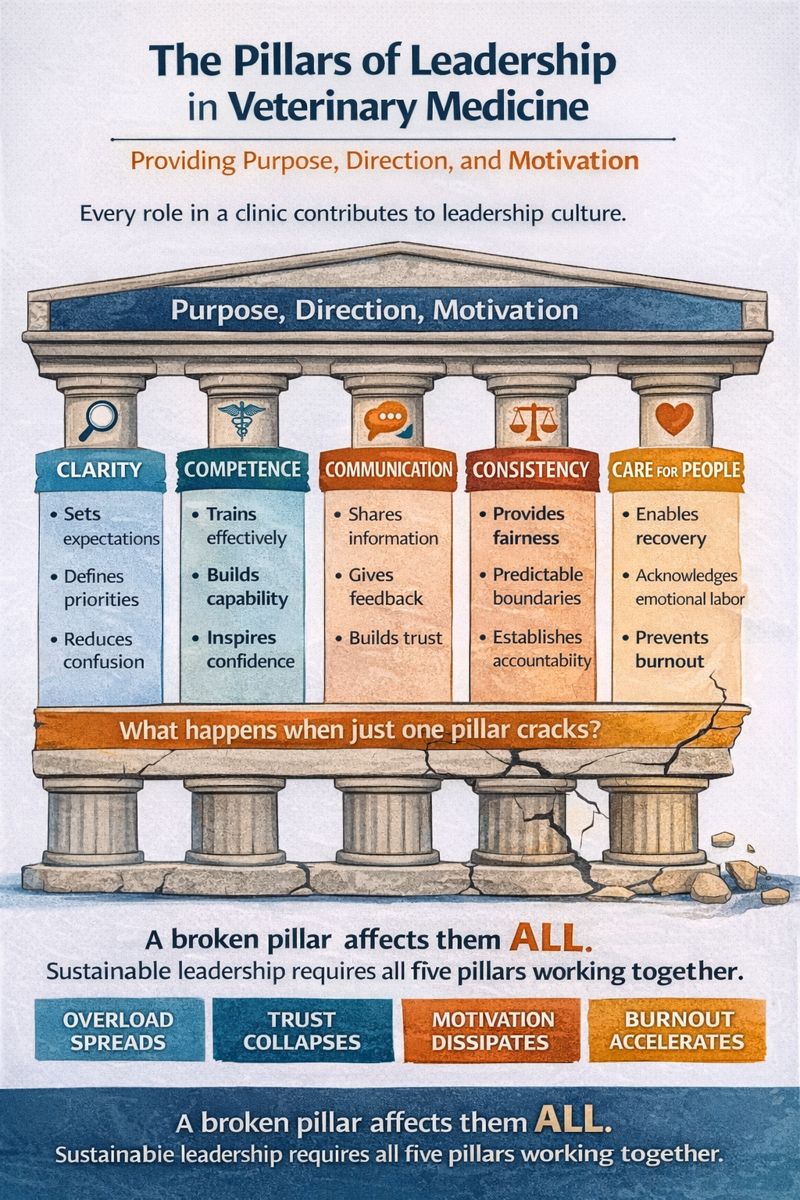
The Five Pillars of Leadership in Veterinary Medicine
- Clarity
- Competence
- Communication
- Consistency
- Care for People
Each pillar reinforces the others. When one weakens, the system destabilizes.
Pillar 1: Clarity (Direction)
Clarity provides direction.
It includes:
- Defined roles and responsibilities
- Clear expectations and priorities
- Transparent decision-making authority
- Predictable standards under stress
Role ambiguity is one of the strongest predictors of stress, burnout, and interpersonal conflict (Kahn et al., 1964).
When Clarity Fails
- Technicians guess what success looks like
- Receptionists absorb client frustration
- Assistants overextend to fill gaps
- Kennel staff receive conflicting instructions
- Veterinarians carry unnecessary cognitive load
- Managers spend time firefighting instead of leading
Without clarity, people don’t stop working.
They work harder—and burn out faster.
Pillar 2: Competence (Credible Direction and Motivation)
Competence makes leadership trustworthy.
It is not perfection. It is the ability to perform one’s role effectively with appropriate training, scope, and support.
This includes:
- Clinical competence
- Leadership and people-management competence
- Emotional regulation
- Ethical and legal judgment
Research shows that technical expertise alone does not prepare clinicians to lead people (Goleman, 2000).
When Competence Fails
- Technicians compensate for leadership gaps
- Assistants are pushed beyond training
- Receptionists manage emotional crises without tools
- Veterinarians lead teams without leadership education
- Managers inherit authority without development
When leaders lack competence, motivation erodes—not because people don’t care, but because trust collapses.
Pillar 3: Communication (Purpose and Direction)
Communication is how purpose and direction are transmitted daily.
It includes:
- Expectations
- Feedback
- Conflict navigation
- Information sharing
- Tone, timing, and follow-through
Poor communication is a primary driver of disengagement and psychological unsafety (Edmondson, 2018).
When Communication Fails
- Teams become defensive
- Rumors replace information
- Feedback feels personal instead of developmental
- Psychological safety deteriorates
Silence does not remove uncertainty.
It amplifies it.
Pillar 4: Consistency (Motivation Through Fairness)
Consistency sustains motivation by creating fairness and predictability.
It means:
- Policies applied evenly
- Boundaries enforced fairly
- Expectations upheld across roles and shifts
- Accountability without favoritism
Inconsistent leadership undermines trust and increases emotional exhaustion, especially in high-pressure environments (Maslach & Leiter, 2016).
When Consistency Fails
- Technicians see favoritism
- Assistants feel invisible
- Receptionists absorb blame for shifting rules
- Kennel staff feel undervalued
- Managers lose credibility
Inconsistency teaches teams that effort is less important than proximity to power.
Pillar 5: Care for People (Sustainable Motivation)
Care for people sustains long-term motivation.
It does not mean avoiding accountability.
It means designing work that respects human limits.
This includes:
- Sustainable workloads
- Acknowledgment of emotional labor
- Protection of dignity under pressure
- Systems that support recovery
Burnout research consistently shows that organizational conditions—not individual weakness—drive exhaustion and disengagement (Maslach & Leiter, 2016; Bakker & Demerouti, 2017).
When Care for People Fails
- Burnout accelerates
- Moral distress increases
- Errors rise
- Compassion fatigue deepens
- Turnover becomes normalized
When care is absent, leadership becomes extractive.
How Failure in One Pillar Undermines Purpose, Direction, and Motivation
Leadership breakdowns are rarely isolated.
- Poor communication erodes clarity
- Inconsistency undermines motivation
- Lack of competence damages trust
- Absence of care accelerates burnout
- Unclear roles overload every position
When one pillar cracks, the others strain to compensate—until the system fails.
This is not an individual failure.
It is a leadership system failure.
Leadership Exists at Every Level
Leadership is not reserved for titles.
- A receptionist who de-escalates a client provides direction
- A technician who mentors a peer reinforces purpose
- A kennel staff member who notices stress sustains care
- A veterinarian who models calm stabilizes motivation
- A manager who protects boundaries preserves trust
When leadership systems are healthy, people at all levels can lead without burning out.
The Takeaway
The purpose of leadership in veterinary medicine is clear:
To provide purpose, direction, and motivation in environments that would otherwise overwhelm people.
That purpose is fulfilled—or undermined—through clarity, competence, communication, consistency, and care.
When all five pillars are present, teams feel:
- Anchored in meaning
- Clear about expectations
- Motivated without being depleted
When one fails, everyone feels it.
Leadership should be designed with the same care as medicine itself—ethically, intentionally, and with the whole system in mind.
Reflection Question
Where is your clinic strongest at providing purpose, direction, or motivation—and where is the system breaking down?
References (APA)
Bakker, A. B., & Demerouti, E. (2017). Job demands–resources theory: Taking stock and looking forward. Journal of Occupational Health Psychology, 22(3), 273–285. https://doi.org/10.1037/ocp0000056
Edmondson, A. C. (2018). The fearless organization: Creating psychological safety in the workplace for learning, innovation, and growth. Wiley.
Goleman, D. (2000). Leadership that gets results. Harvard Business Review, 78(2), 78–90.
Kahn, R. L., Wolfe, D. M., Quinn, R. P., Snoek, J. D., & Rosenthal, R. A. (1964). Organizational stress: Studies in role conflict and ambiguity. Wiley.
Kotter, J. P. (1990). A force for change: How leadership differs from management. Free Press.
Maslach, C., & Leiter, M. P. (2016). Understanding the burnout experience. World Psychiatry, 15(2), 103–111. https://doi.org/10.1002/wps.20311
Northouse, P. G. (2022). Leadership: Theory and practice (9th ed.). Sage.
 Heart and Mind VetMed
Leave a comment